
First of the Gang to Die....
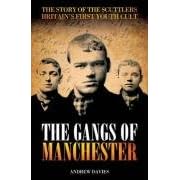 Way back in August I referred to a phenomenon from the nineteenth century known a 'scuttling'. A purely Mancunian word to describe a particularly Mancunian approach to juvenile gang warfare. It's not that gang warfare didn't exist in other industrial cities, it's just that the Mancunian approach concentrated on violence without the petty theft that often accompanied it in other areas. Oh, and the fact that it was called 'scuttling' and the perpetrators were called 'scuttlers' was uniquely Mancunian also.
As a result of that post and a fairly long quotation from an online paper on the subject, I received a comment from the author of the paper – Andrew Davies, a senior lecturer in history at the University of Liverpool and one time resident of Salford. In an Obama-like internet call to arms Andrew thanked me for the post and informed that his book – The Gangs of Manchester (The Story of the Scuttlers) had just been published. I bought it. I read it. I enthused about it. I became a bit of a bore about it (probably) . And now I've got other people reading it and hopefully embracing the history that's all around them.
The places referred to in the book are part of my very DNA. My entire childhood was peppered with the names of faraway places like Ancoats, Miles Platting, Harpurhey, Collyhurst, New Cross, Gorton, Ardwick.....and not one of these places more than four or five miles away from my home in what seemed (at the time) like the countryside of Failsworth/Woodhouses. But they were all, even in the late Fifties and Sixties talked about as though the very Devil himself lurked within. Teddy Boys, Tinkers and Bogey Men were all to be found from Newton Heath onwards as you headed towards Manchester and woe-betide any poor unfortunate who dared cross the edge of Failsworth into the badlands.
The book opens with a trip back to the the night of Sunday, August 3rd 1890 as a gang of youths from Harpurhey march towards Manchester, armed with the Scuttler's stock-in-trade weaponry of knives and heavy-buckled belts to meet the most notorious gang in Manchester – The Bengal Tigers. As it happens the Harpurhey crew (posse?) were victorious that night though four of them were sentenced, two to five years' penal servitude, one for twelve months and one for six months.
A fifth – John Ford – had an alibi and was acquitted. John Ford. The name jumped out at me from page three. John Ford. Harpurhey, John Ford. My maternal grandad was called John Ford. He was originally from Harpurhey. His family had been there for years . His family had a habit (or maybe a tradition) of naming their first born sons John. Just like I did when I first became a dad. Now the John Ford referred to couldn't have been my grandad as he was born in 1910 or thereabouts but it is possible, just possible that the acquittee is some relation. I'll be rootling around Ancestry dot com over the coming weeks.
Apart from the frisson of excitement at the name though, there is much working class and proto-underclass history in these pages. The squalor of the living conditions, the mindless repetitive work, when available, the draw of the pub, the lack of education, the lack of constructive leisure activities, the lack of aspiration.
Fascinating. Get it bought and read and stop believing the Daily Mail when it keeps telling you that youthful gang violence, stabblings and murder are a unique product of the modern world , the likes of which we have never seen before.


3 comments:
How much did Andrew Davies give you to promote his book?
Facinating to see the evidence that marauding urban gang culture has been with us for so long.
Yea, I read it too! Apart from anything else, its good to read about Manchester's History .
Interestingly, everybody thinks they know about London/Dickens/etc Yet We up 'ere have just as big ,unique & poignant shadow..........
Hello again. I owe you a big thank-you. Glad you enjoyed the book. I was absolutely gripped by the stories in the Victorian newspapers. It's good to share them and I'm glad now that I used real names in the book. Quite a few people have found their relatives in there and last week I had tea with the niece of one of the most famous scuttlers of them all. She's eighty-one and lives in Ancoats. You might be interested in a new play inspired by the book, to be staged at Middleton Arena and then at the Library Theatre in August: Angels with Manky Faces. Details are now on the Library Theatre's website. All the best, Andy
Post a Comment